
Our Call to Action:
Whether it’s a problem with alcohol, opioids, cocaine, misuse of legally prescribed drugs, or any other substance, Substance Use Disorder kills thousands of Americans every year and impacts millions of lives.
Substance Use Disorder compels someone to repeatedly use substances or engage in behaviors even though they have harmful consequences. This behavior threatens a person’s basic health and safety, destroys the critical development of life skills and outcomes, and damages emotional development and relationships.


Click the images to see the resources behind our stats.
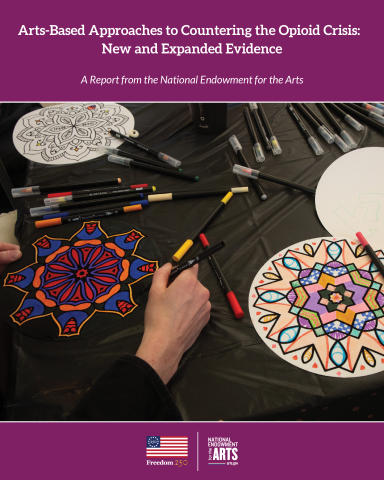
Arts-Based Approaches to Countering the Opioid Crisis: New and Expanded Evidence
A Report from the National Endowment for the Arts
The National Endowment for the Arts (NEA) has updated a report first published in 2020 to include new statistics and used Hope Creates as one of their case studies.
Key Conclusions
Opioid misuse remains a major public health and economic challenge. About 7.1 million Americans aged 12+ misused opioids in 2025, while, according to White House estimates, the broader economic costs of illicit opioid use reached $2.7 trillion in 2023.
A new report from the National Endowment for the Arts highlights the arts’ role in addressing this crisis. The report describes evidence-based approaches involving the arts for pain management, opioid misuse prevention, treatment, and recovery.
New evidence is encouraging: The review identified 69 unique studies from 2020 through 2025, with 55 (nearly 80%) reporting positive findings and the remaining studies finding mixed or neutral results. No studies showed uniformly negative results.
Music interventions dominate the evidence: 56 of 69 studies (81%) examined music-based approaches, including music therapy and music-listening. The strongest and most consistent results are for pain management. In general, reported benefits from music interventions include:
Reduced pain intensity
Improved physical functioning
Better quality of life
Improved emotional well-being
Regarding substance abuse prevention and treatment, evidence about the arts’ role is emerging: Studies suggest arts interventions may support treatment engagement, readiness for change, and reduced craving, although this research base is less developed than evidence for music and pain management.
Programs are already operating across diverse settings: A program scan identified 33 programs, initiatives, and policy/funding mechanisms spanning clinical and community settings and veteran, Indigenous, justice-involved, and youth populations.
A key gap remains between research and practice: Research is most developed for music and clinical pain management, while existing programs are applying the arts much more broadly to prevention and recovery, including in culturally grounded and community settings.
The report calls for greater collaboration and faster implementation: Researchers, arts and health professionals, and drug counselors should work together to implement, evaluate, and scale evidence-based arts interventions in clinics and communities.
In conclusion, growing evidence suggests that arts-based approaches—particularly music—can complement opioid misuse prevention, treatment, and recovery efforts and may help reduce pain while improving quality of life, emotional well-being, and readiness for treatment.